


Australian unemployment surged in May and the economy shed almost three times as many jobs as forecast amid restrictions to stem the spread of the pandemic. The currency tumbled.
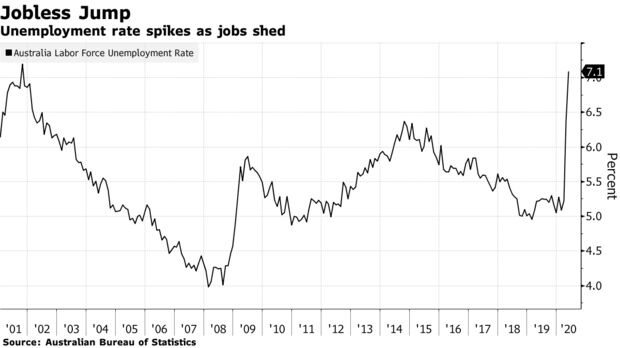
The jobless rate climbed to 7.1% from a revised 6.4% in April, data from the Australian Bureau of Statistics showed in Sydney Thursday. Employment plunged by 227,700 in May, compared with a forecast 78,800 drop, and April’s fall was upwardly revised to 607,400. The result was worse than expected by every economist bar one.
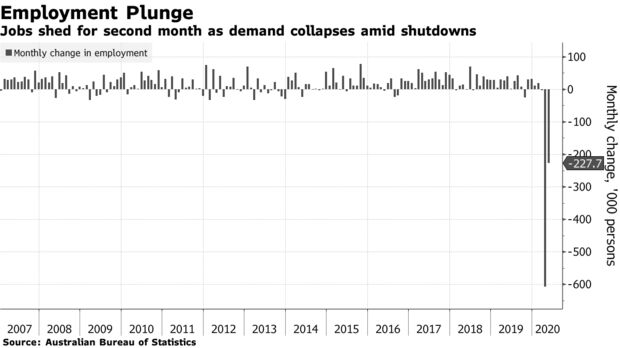
Participation tumbled to 62.9%, the lowest level since the start of 2001, as people who lost their job saw little hope in searching for another. The Australian dollar fell after the release, trading at 68.51 U.S. cents at 12:08 p.m. in Sydney.
Despite today’s result, the path ahead is promising as infection rates have fallen and restrictions are being relaxed amid a staged reopening of the economy. The question is how much this data will impact sentiment, given consumer confidence returned to near pre-coronavirus levels in June and the central bank suggested the downturn might be “shallower” than earlier thought.
Today’s data also showed:
- Full-time employment fell 89,100; part-time tumbled 138,600
- The under-utilization rate that combines unemployment and under-employment was almost unchanged at 20.2%
- Monthly hours worked fell 0.7% in May, to be down 10.2% since March, as the April fall was revised up to 9.5%
The RBA has said that hours worked will be a key metric to gauge the hit to the economy, as the government’s JobKeeper initiative keeps workers attached to employers during the shutdown, which together with the fall in participation, limits some of the increase in official unemployment.
On a more positive note, the central bank said this month that while job losses and fewer hours for those still in work had reduced income, government support had provided a considerable offset.
“Households that were already receiving welfare payments had received additional payments, and the JobKeeper program and increased JobSeeker payments had supported incomes for others,” the RBA said in minutes of its June policy meeting released Tuesday.
Yet there is a lot of slack in the labor force to absorb in the months ahead. Qantas Airways Ltd. in March furloughed most of its 30,000-strong workforce and rival Virgin Australia Holdings Ltd. stood down 80% of its workforce. Star Entertainment Group Ltd. furloughed 90% of its 9,000 employees.
Part of Australia’s improved outlook has been the authorities’ success in flattening the curve of new infections that’s allowing it to relax lockdown restrictions early. The government is aiming to reopen much of the economy, while international borders will remain closed.
Source: Bloomberg